AI Restaurant Discovery: How ChatGPT and Claude Find Local Restaurants
2026-05-16
AI restaurant discovery works by combining training data from restaurant websites, reviews, and articles with live search results to match user queries with relevant dining options. AI assistants like ChatGPT, Claude, and Perplexity don't just randomly suggest restaurants — they analyze query context, location parameters, and specific requirements to surface establishments that match user needs.
The discovery process varies between AI platforms, but most follow similar patterns: parsing user intent, filtering by geographic and preference constraints, then ranking options based on relevance signals from their training data and real-time search integration.
What data sources do AI assistants use for restaurant recommendations?
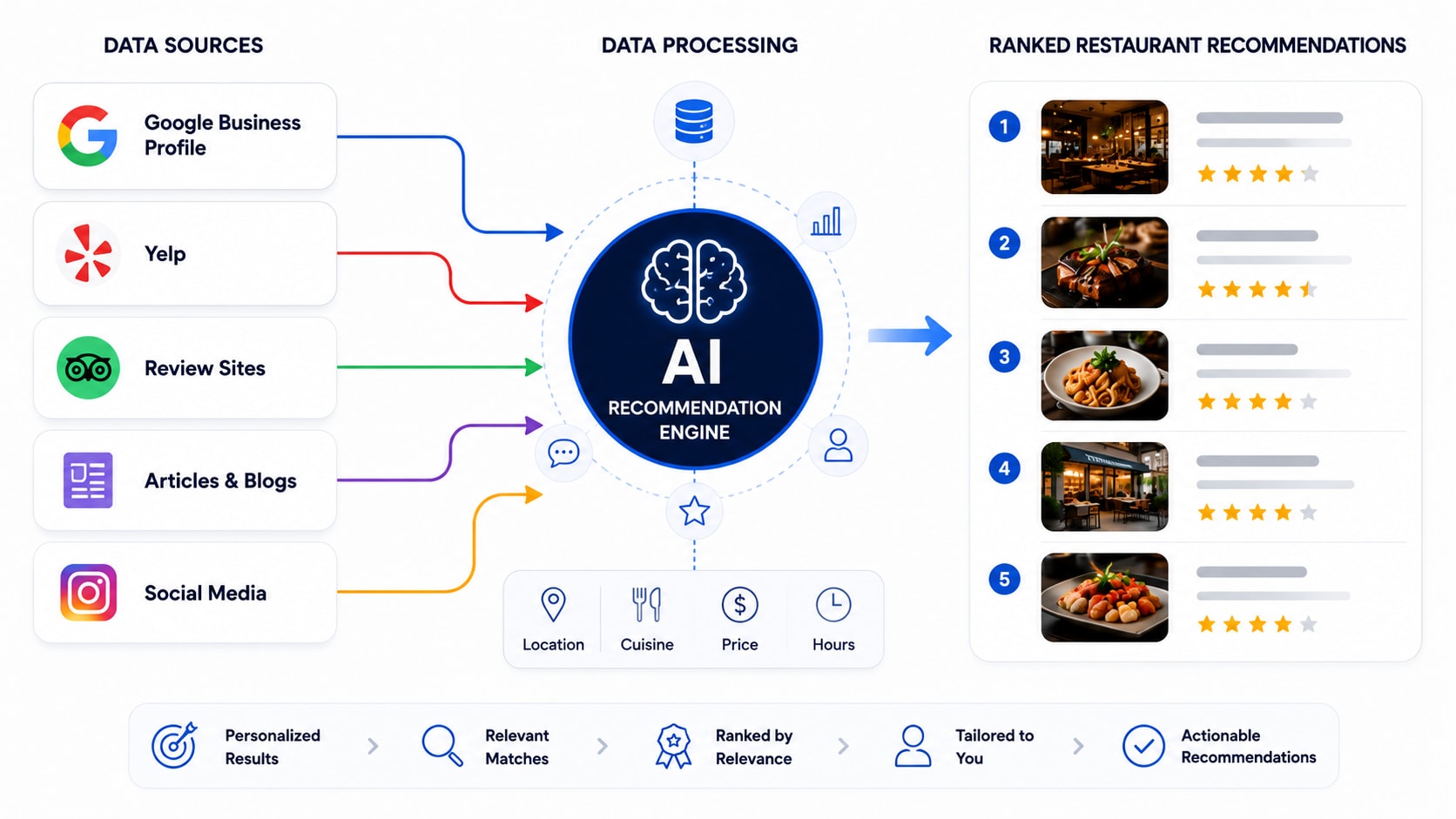
AI assistants draw restaurant recommendations from multiple data layers, creating a composite understanding of dining options that goes beyond simple directory listings.
Training data forms the foundation — information from restaurant websites, food blogs, review sites, local publications, and social media that was included in the AI's initial learning process. This creates baseline knowledge about restaurants that existed and were discussed online before the AI's training cutoff date.
Live search integration adds currency to recommendations when available. ChatGPT with search capabilities, for example, can access current business listings, recent reviews, updated hours, and real-time availability when making suggestions.
Business directory information from Google Business Profile, Yelp, OpenTable, and similar platforms provides structured data about locations, cuisines, price ranges, and operational details that AI systems can quickly parse and filter.
Review and rating aggregation helps AI systems understand restaurant quality and characteristics based on customer feedback patterns. However, AI assistants typically don't rely solely on ratings — they analyze review content for specific attributes mentioned by diners.
The weight given to each data source varies by platform and query type. Local discovery queries may prioritize live search results, while cuisine-specific questions might rely more heavily on training data from food publications.
How do different AI platforms approach restaurant discovery?
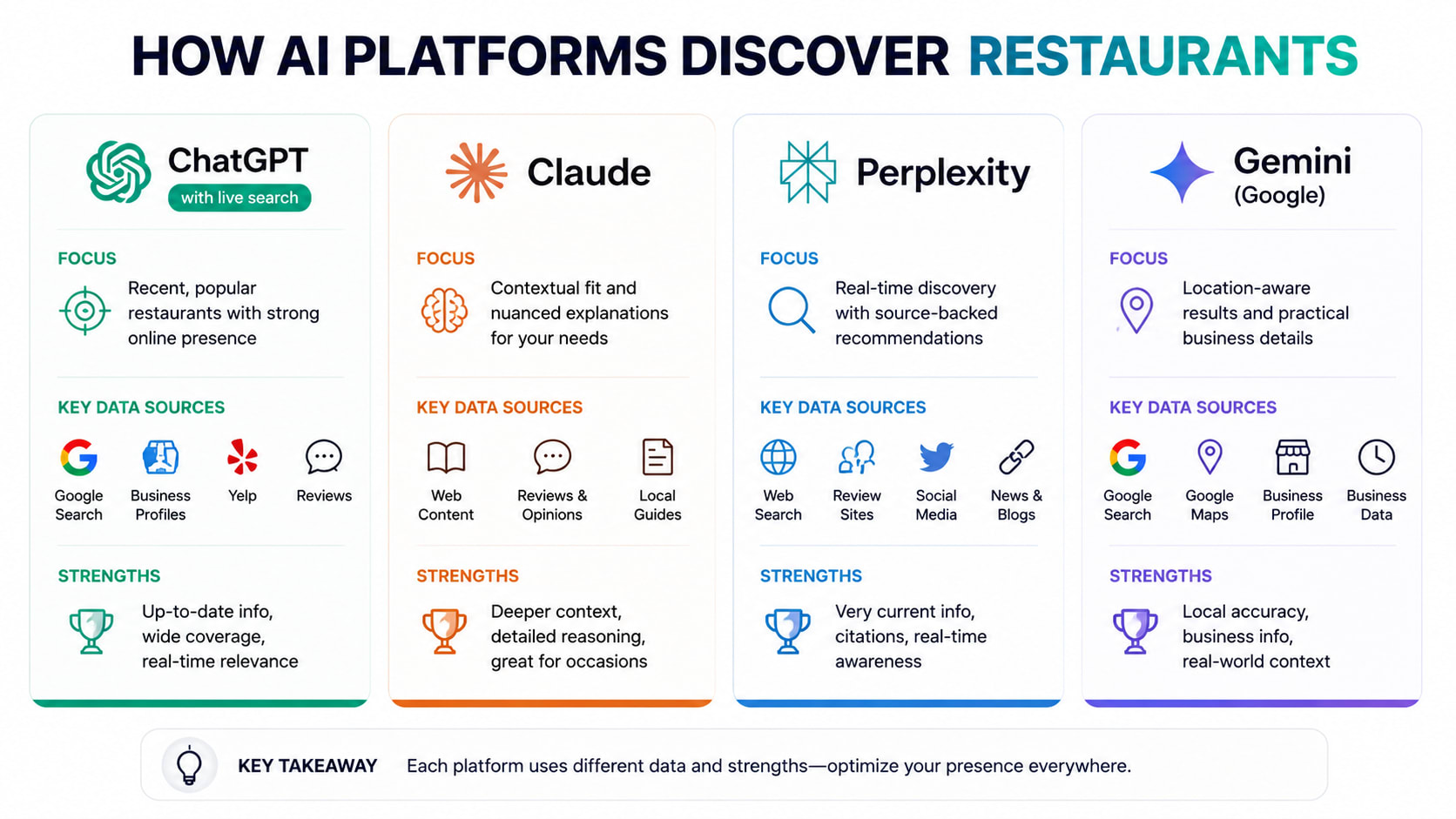
Each major AI platform has developed distinct approaches to restaurant discovery, reflecting their different data sources, search integrations, and optimization priorities.
ChatGPT with live search tends to favor businesses with strong online presence and recent activity. Its recommendations often include establishments that appear prominently in Google search results and have current, detailed business listings across multiple platforms.
Claude's restaurant suggestions typically emphasize contextual appropriateness and detailed explanations of why specific restaurants fit user requirements. Claude often provides more nuanced analysis of atmosphere, cuisine authenticity, and specific dish recommendations.
Perplexity's discovery process leverages real-time web search heavily, often incorporating very recent reviews, social media mentions, and current operational status. Perplexity frequently cites specific sources for its restaurant recommendations.
Google's Bard (Gemini) integrates deeply with Google's business data, making it particularly effective for location-based queries and questions about practical details like hours, reservations, and current availability.
These platform differences mean restaurant optimization strategies should account for varying discovery mechanisms rather than assuming one approach works universally.
What makes a restaurant discoverable by AI?
AI restaurant discoverability depends on having clear, consistent, and accessible information across the channels that feed into AI systems. The most discoverable restaurants share several key characteristics.
Comprehensive online presence with consistent basic information — name, address, hours, cuisine type, price range — across all major platforms. AI systems struggle with conflicting information and may exclude restaurants when they encounter inconsistencies.
Distinctive characteristics clearly communicated through website content, business descriptions, and customer reviews. Restaurants that can be easily categorized and differentiated perform better in AI recommendations than those with vague or generic descriptions.
Current operational status and information signals to AI systems that the business is active and reliable. Restaurants with outdated hours, expired menu links, or stale social media presence may get filtered out of recommendations.
Structured data implementation through llms.txt files, schema markup, or other AI-readable formats makes restaurant information directly accessible to AI systems without requiring interpretation of unstructured web content.
Geographic context optimization ensures the restaurant appears in location-based queries. This includes accurate geographic tags, neighborhood associations, and local landmark references that help AI systems understand where the restaurant fits geographically.
How can restaurants optimize for specific AI discovery scenarios?
Different types of AI queries require different optimization approaches. Understanding common discovery scenarios helps restaurants optimize for the searches that matter most to their business model.
Location-based discovery ("restaurants near me," "good dinner in [neighborhood]") relies heavily on accurate geographic information and local SEO signals. Restaurants should ensure their business listings include precise location data and neighborhood context.
Cuisine-specific queries ("best Thai restaurant," "authentic Italian food") depend on clear cuisine categorization and evidence of authenticity or quality in that category. This includes menu content, chef backgrounds, and review themes that establish credibility in specific cuisines.
Occasion-based searches ("date night restaurants," "business lunch spots," "family-friendly dining") require optimization around atmosphere, service style, and practical considerations. Restaurant descriptions should explicitly address different dining occasions and their requirements.
Constraint-based queries ("vegetarian restaurants," "restaurants under $30," "places that take reservations") need clear information about accommodations, pricing, and operational policies that AI systems can easily identify and match to user requirements.
Specialty or signature dish searches ("best burger in [city]," "where to get good ramen") benefit from having signature dishes clearly highlighted across online presence and in customer review patterns.
What role does customer feedback play in AI discovery?
Customer reviews, ratings, and social media mentions significantly influence how AI systems understand and recommend restaurants, but not always in obvious ways.
Review content matters more than ratings. AI systems analyze what customers specifically mention about restaurants — atmosphere, service style, particular dishes, value — rather than just aggregating star ratings. Detailed reviews that mention specific characteristics help AI systems understand when to recommend particular restaurants.
Consistency in customer feedback across platforms strengthens AI understanding of restaurant characteristics. When multiple customers mention the same distinctive features, AI systems develop more confidence in those attributes.
Recent feedback carries more weight in AI systems with live search capabilities. Current reviews and social media mentions help AI assistants verify that restaurant characteristics remain accurate and that the business is actively operating.
Authentic feedback performs better than obviously promotional content. AI systems increasingly recognize and discount fake reviews or overly promotional language, favoring genuine customer experiences in their recommendation algorithms.
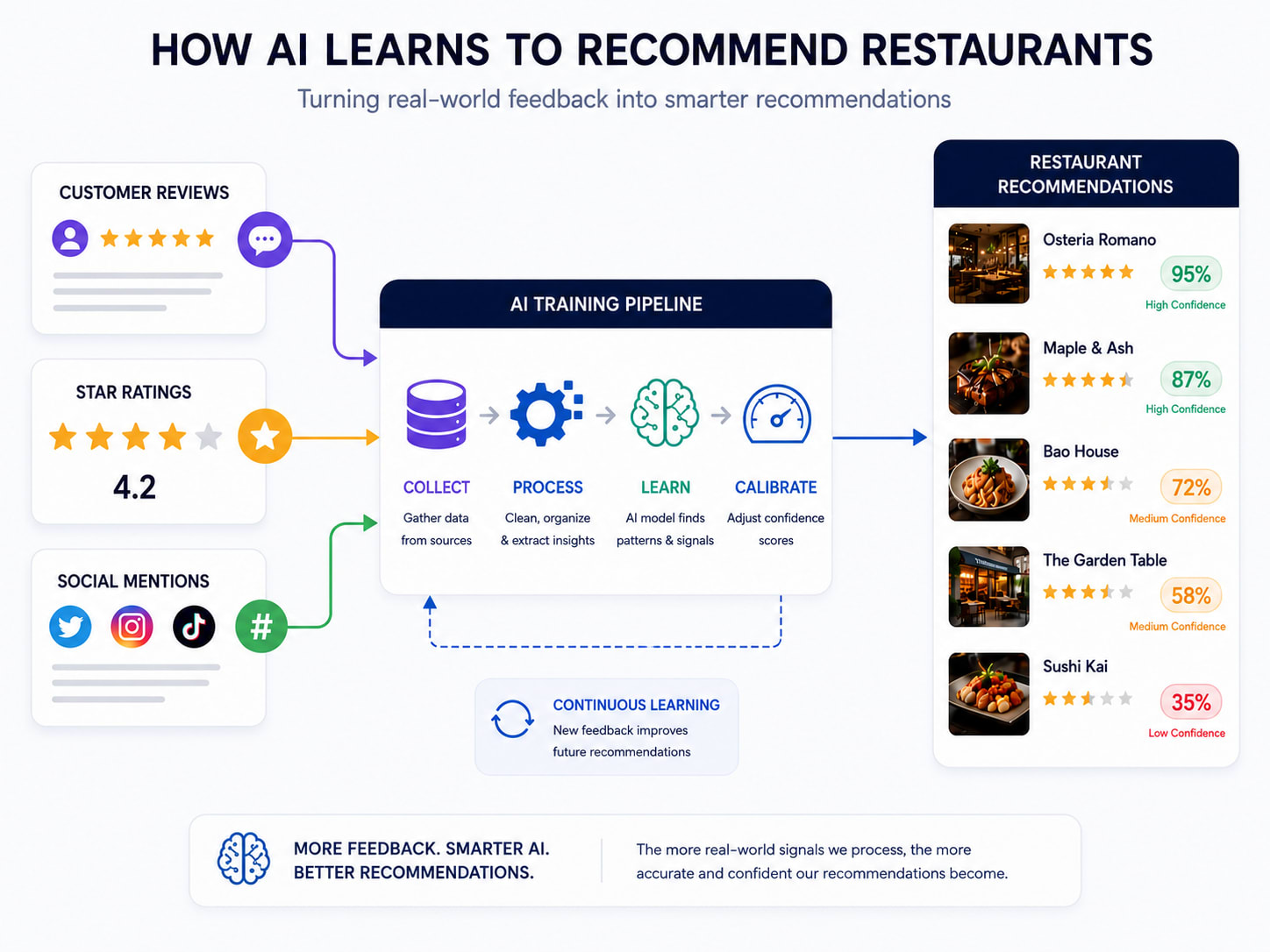
Negative feedback context matters as much as positive reviews. AI systems can distinguish between minor complaints and fundamental problems, sometimes recommending restaurants despite negative reviews when those reviews don't relate to the user's specific query.
How should restaurant owners monitor their AI discovery performance?
Tracking AI discovery requires different approaches than traditional marketing measurement, since AI recommendation patterns can vary significantly from search engine or social media visibility.
Direct testing across platforms provides the most reliable performance data. Regularly query major AI assistants with searches relevant to your restaurant — location-based queries, cuisine searches, specific occasions — and track when and how your restaurant appears in results.
Geographic and timing variation in testing reveals how consistently your restaurant appears across different query contexts. Test from different locations and at different times to understand baseline AI visibility.
Query type analysis helps identify which types of searches successfully surface your restaurant versus which leave you invisible. This guides optimization efforts toward improving performance in high-value discovery scenarios.
Competitive monitoring shows how your AI visibility compares to similar restaurants in your market. Understanding when competitors appear instead of your restaurant reveals optimization opportunities.
Customer feedback about discovery can reveal when AI recommendations drive foot traffic. Simple questions at host stands or in post-meal surveys help track AI-driven customers and understand which platforms direct traffic most effectively.
Most restaurants find that AI discovery performance improves gradually with sustained optimization efforts rather than dramatic immediate changes.
What common mistakes reduce AI discoverability?
Several optimization mistakes can actually hurt restaurant discoverability in AI systems, often because they create confusion or inconsistency that AI algorithms struggle to resolve.
Information inconsistency across platforms confuses AI systems about basic facts. Different hours on Google versus Yelp, varying cuisine descriptions, or conflicting price ranges can result in AI systems excluding the restaurant from recommendations rather than risking inaccurate suggestions.
Generic or vague descriptions make it difficult for AI systems to understand when your restaurant fits specific queries. Descriptions like "great food and atmosphere" don't provide the specific characteristics AI systems need to match restaurants to user requirements.
Outdated information signals to AI systems that the business may not be reliable or current. Expired menu links, old social media posts, or incorrect hours can reduce AI recommendation confidence.
Over-optimization or keyword stuffing in business descriptions may trigger AI spam detection. Focus on accurate, helpful descriptions rather than trying to game AI algorithms with excessive keywords.
Neglecting negative feedback rather than responding appropriately can amplify problems in AI understanding. Unaddressed legitimate complaints may become prominent signals that AI systems use to evaluate restaurant quality.
Ignoring structured data opportunities like llms.txt files or schema markup means missing chances to provide clear, AI-readable information that could improve discovery performance.
The goal should be authentic, consistent, and helpful information rather than attempting to manipulate AI recommendation algorithms.
What's next for AI restaurant discovery?
AI restaurant discovery will likely become more sophisticated and personalized as AI platforms develop better understanding of user preferences, dining history, and contextual requirements.
Personalization improvements may allow AI systems to learn individual user preferences and provide more tailored recommendations based on past dining choices and feedback patterns.
Real-time integration with reservation systems, delivery platforms, and POS data could enable AI assistants to recommend restaurants based on current availability, wait times, and live operational status.
Voice and visual search integration may change how customers discover restaurants, requiring optimization for spoken queries and image-based searches in addition to text-based recommendations.
Local integration with neighborhood data, events, and hyperlocal trends could make AI discovery more contextually aware of what's happening in specific areas at specific times.
Restaurant owners should focus on building solid foundations for AI discovery — accurate information, clear characteristics, consistent online presence — that will serve them well regardless of how AI discovery technology evolves.
The restaurants that succeed in AI discovery will be those that provide clear value to customers and communicate that value consistently across the digital channels that feed into AI training and search systems.