How to Get ChatGPT Restaurant Recommendations That Actually Work
2026-05-16
ChatGPT recommends restaurants based on training data and live search integrations, but strategic prompts unlock hidden gems over expensive defaults. Most users get generic suggestions because they ask generic questions — the difference between "good restaurant near me" and "quiet Italian spot under $30 per person in Williamsburg with outdoor seating" determines whether you discover a neighborhood favorite or get pointed toward the same three Michelin-starred places everyone already knows about.
The problem isn't ChatGPT's capabilities. It's that ChatGPT makes recommendations based on a combination of its training data and live integrations (like Bing or ChatGPT Search), and that training data skews toward well-documented, frequently-mentioned establishments rather than the hidden gems locals actually visit.
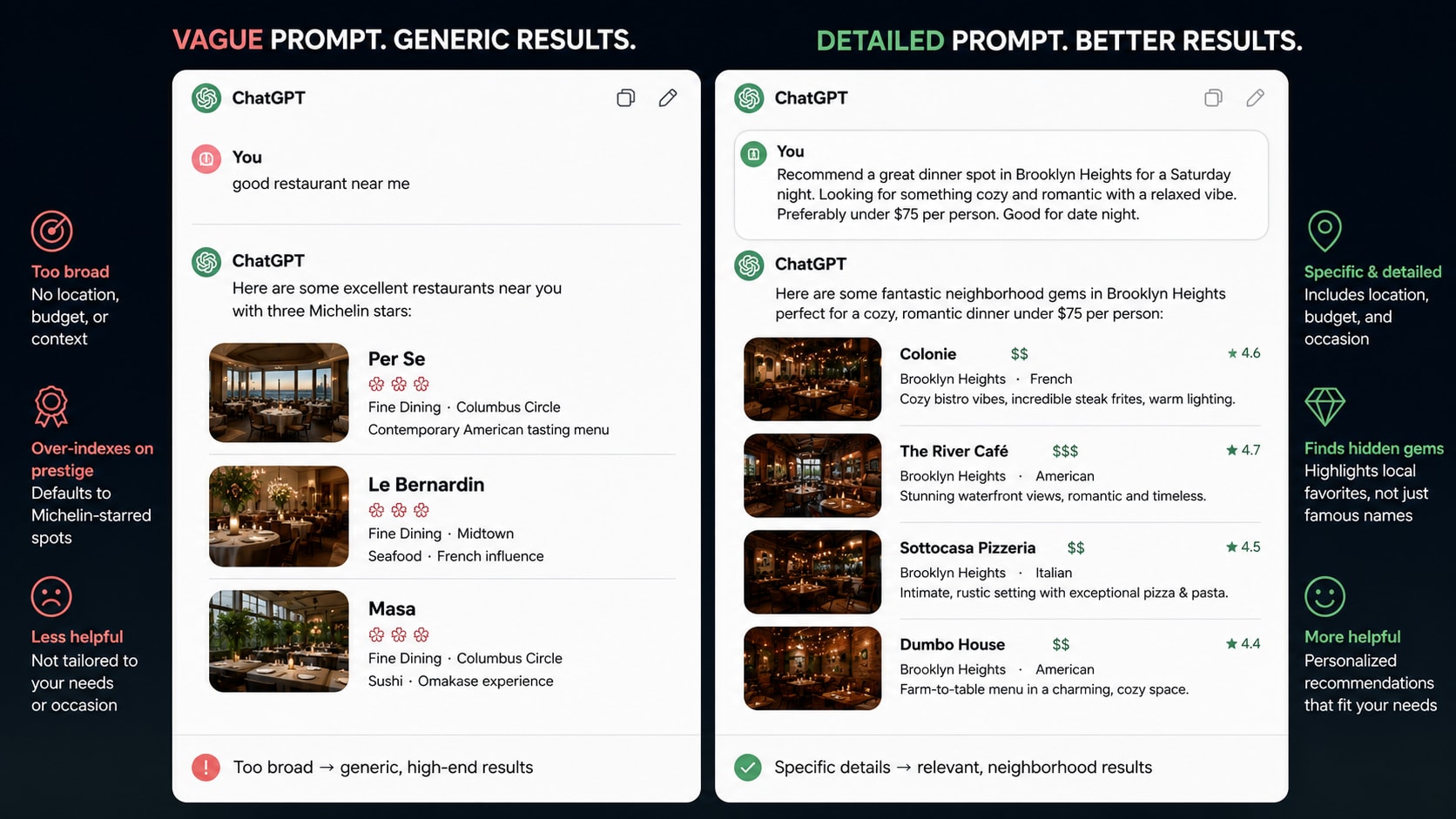
Why ChatGPT's default restaurant suggestions often miss the mark?
When you ask ChatGPT for restaurant recommendations without specific parameters, you're essentially asking it to surface the most frequently mentioned establishments in its training data. ChatGPT almost always lists Eleven Madison Park, Per Se, and Masa — three venues that local critics have questioned for their prices when users ask for "splurge" meal options in New York.
The AI doesn't understand nuance the way a local friend would. It can't distinguish between a restaurant that gets written about because it's genuinely excellent and one that gets coverage because it's expensive or controversial. Training data reflects media coverage, not necessarily quality or value.
This creates predictable blind spots: neighborhood gems that don't get food blog coverage, ethnic restaurants in outer boroughs, family-owned spots that have been quietly serving regulars for decades. ChatGPT knows about the places that get talked about online. It doesn't know about the places that don't need to be talked about because locals just go there.
What makes a ChatGPT restaurant prompt actually work?
Effective restaurant prompts work like good search queries — they include constraints that help the AI filter toward relevant options rather than defaulting to the most commonly mentioned results.
Location specificity matters more than you think. "Near Bryant Park in Manhattan" performs better than "in NYC" because it activates different sets of training data. The underrated spots I found near Bryant Park in Manhattan are Café China, DONDON KOREAN BBQ, Mitr Thai and Los Tacos No. 1 — results that wouldn't surface with a broader geographic prompt.
Price anchors prevent expensive defaults. Include "under $25 per person" or "casual lunch spot" to avoid the Eleven Madison Park problem. ChatGPT interprets these as filters, not just preferences.
Cuisine plus atmosphere beats cuisine alone. "Thai restaurant" gets you generic results. "Thai restaurant with a cozy atmosphere for a quiet date" activates different recommendation pathways in the training data.
Time constraints surface practical options. "Open late" or "good for lunch meetings" helps ChatGPT filter toward restaurants that actually serve your use case rather than just matching cuisine preferences.
![Prompt formula graphic: [Specific neighborhood] + [Cuisine type] + [Price ceiling] + [Occasion] + [1–2 local signals] = hidden gem results. Each variable shown as a labeled building block.](https://res.cloudinary.com/dkw4unkzi/image/upload/q_auto/f_auto/v1778923721/2b03174b-8550-4ab7-ba98-71b358d06204.png)
How do you craft prompts that surface hidden gems instead of Michelin stars?
The most effective discovery prompts combine geographic specificity with social proof indicators that suggest local knowledge rather than tourist appeal.
Try: "What are the best restaurants in [specific neighborhood] that locals actually eat at regularly, under [price range], known for [specific dish or atmosphere]?" This prompt structure signals that you want insider knowledge, not guidebook recommendations.
Ask for places with specific characteristics that tourists don't typically seek: "family-owned," "cash-only," "no reservations needed," "counter seating," "BYOB." These indicators correlate with local favorites that don't get heavy media coverage.
Request restaurants by what they're known for locally. Instead of asking for "Italian restaurants," ask for "places known for having the best carbonara" or "Italian spots where the owner's mother still makes the pasta." Specificity drives ChatGPT toward establishments known for particular dishes rather than general cuisine categories.
Include social proof that suggests authenticity: "places where you see the same customers every week" or "restaurants where the staff recognizes regulars." These social signals help ChatGPT differentiate between community institutions and trendy spots.
Can ChatGPT find restaurants that match your specific constraints?
ChatGPT excels at constraint-matching when you provide multiple specific requirements simultaneously. The key is layering constraints in a way that narrows the field without making the request so specific that no restaurants qualify.
Dietary restrictions plus atmosphere: "Vegan-friendly restaurants in Portland with outdoor seating and a casual vibe, good for bringing kids." This combination helps ChatGPT filter toward family-oriented spots rather than upscale vegan restaurants.
Time and logistics constraints: "Restaurants near Union Square that are good for a business lunch, take reservations same-day, and have quiet enough atmosphere for conversation." These practical filters surface restaurants that work for your actual situation.
Cultural or authenticity markers: "Korean restaurants in Queens where Korean families actually eat, not the trendy spots in Manhattan." This prompt leverages ChatGPT's understanding of geographic and cultural context to recommend authentic options over tourist-oriented establishments.
The more specific your constraints, the better ChatGPT performs at surfacing options that match your actual needs rather than defaulting to the most commonly mentioned restaurants in its training data.
What role does live search integration play in ChatGPT recommendations?
When ChatGPT has access to live search capabilities, its restaurant recommendations become significantly more current and locally relevant. Without live search, ChatGPT relies entirely on training data that may be outdated or incomplete.
Live search integration allows ChatGPT to access current information: restaurant hours, recent reviews, seasonal menu changes, and whether a restaurant is temporarily closed. This makes a practical difference when the AI is recommending spots for immediate visits rather than general dining suggestions.
Current vs. training data creates different recommendation patterns. ChatGPT with live search can verify that a restaurant is still open, check current hours, and incorporate recent online mentions. ChatGPT without live search may recommend restaurants that closed months ago or suggest spots with outdated information.
The integration also affects geographic accuracy. Live search helps ChatGPT access location-specific data that may not be well-represented in training data — particularly important for suburban areas or smaller cities where restaurant coverage in articles and reviews is more limited.
For real-time recommendations, always verify independently. Even with live search enabled, ChatGPT's recommendations should be cross-checked with current business information, especially for hours, reservations, and menu availability.
How should restaurant owners ensure ChatGPT recommends their business?
Restaurant owners can influence ChatGPT recommendations by focusing on the data sources that feed into AI training and live search integration. The goal is making your restaurant discoverable and accurately represented in the online information ecosystem.
Maintain accurate, complete business listings. ChatGPT draws from search engines, business directories, and review platforms. Ensure your restaurant's information is consistent across Google Business Profile, Yelp, OpenTable, and other major directories. Include current hours, menu highlights, price range, and contact information.
Create AI-readable content with LLMenu. An llms.txt file makes your restaurant's key information — menu items, specialties, atmosphere, price range — directly accessible to AI systems. This structured format helps ChatGPT understand what makes your restaurant distinctive and when to recommend it.
Focus on specific, searchable differentiators. Instead of generic descriptions ("great food," "cozy atmosphere"), emphasize specific details: signature dishes, unique ingredients, particular occasions you serve ("best brunch spot for large groups," "late-night ramen until 2 AM"). These specifics help ChatGPT match your restaurant to relevant user queries.
Encourage authentic online presence. Regular customers mentioning your restaurant in reviews, social media, or local forums creates the kind of authentic online footprint that AI systems recognize. The goal isn't gaming the system — it's making sure your restaurant's actual strengths are visible to the algorithms that power AI recommendations.
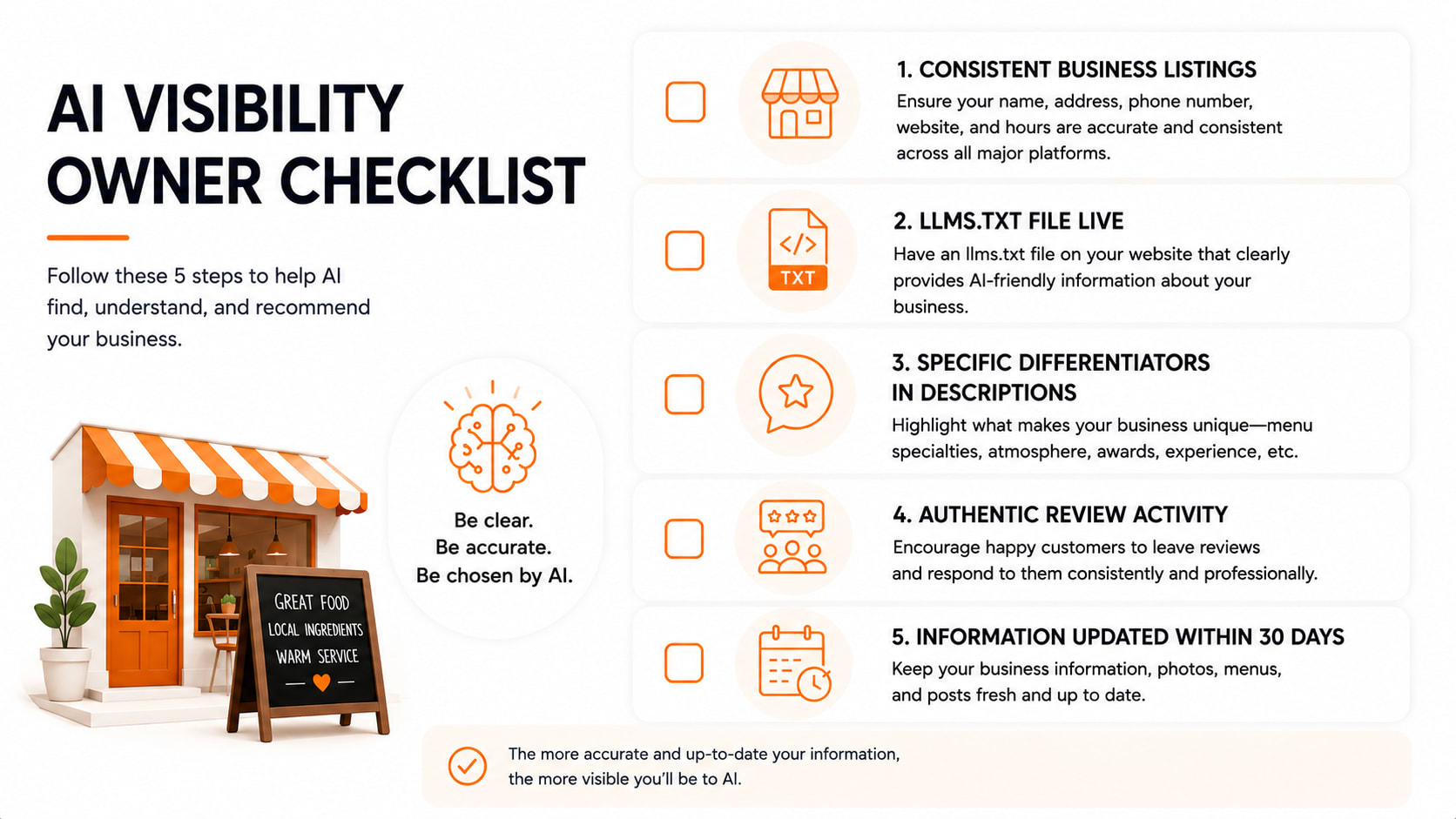
Keep information current. AI systems favor fresh, accurate data. Update your business listings when you change hours, add menu items, or modify pricing. Outdated information reduces the likelihood that ChatGPT will recommend your restaurant confidently.
Frequently Asked Questions
Does ChatGPT always recommend the same restaurants? No. ChatGPT draws from training data and live search integrations, so recommendations vary by prompt specificity, location, and cuisine type. Vague prompts tend to surface well-known establishments; detailed prompts uncover local alternatives.
Why does ChatGPT recommend expensive restaurants when I ask for budget options? ChatGPT's training data overrepresents famous, high-end establishments. To get budget recommendations, explicitly state your price range, neighborhood, and cuisine in your prompt rather than relying on general requests.
Can I use ChatGPT to find restaurants near me right now? ChatGPT with live search enabled can access current restaurant data and hours. Without live search, it relies on training data that may be outdated. Always verify hours and menus independently before visiting.
What information should I include in a restaurant recommendation prompt? Include location (neighborhood or zip code), cuisine type, price range, dietary restrictions, occasion (date night, casual lunch), and any specific atmosphere or feature you want (outdoor seating, quiet, lively). Specificity drives better results.
How can my restaurant get recommended by ChatGPT? Maintain an accurate, complete business listing with current hours, menu, and contact information. Ensure your website is crawlable and your business appears in search results. ChatGPT integrates live data, so visibility in search engines directly impacts AI recommendations.