llms.txt for Restaurants: Complete Guide to AI-Readable Menu Files
2026-05-16
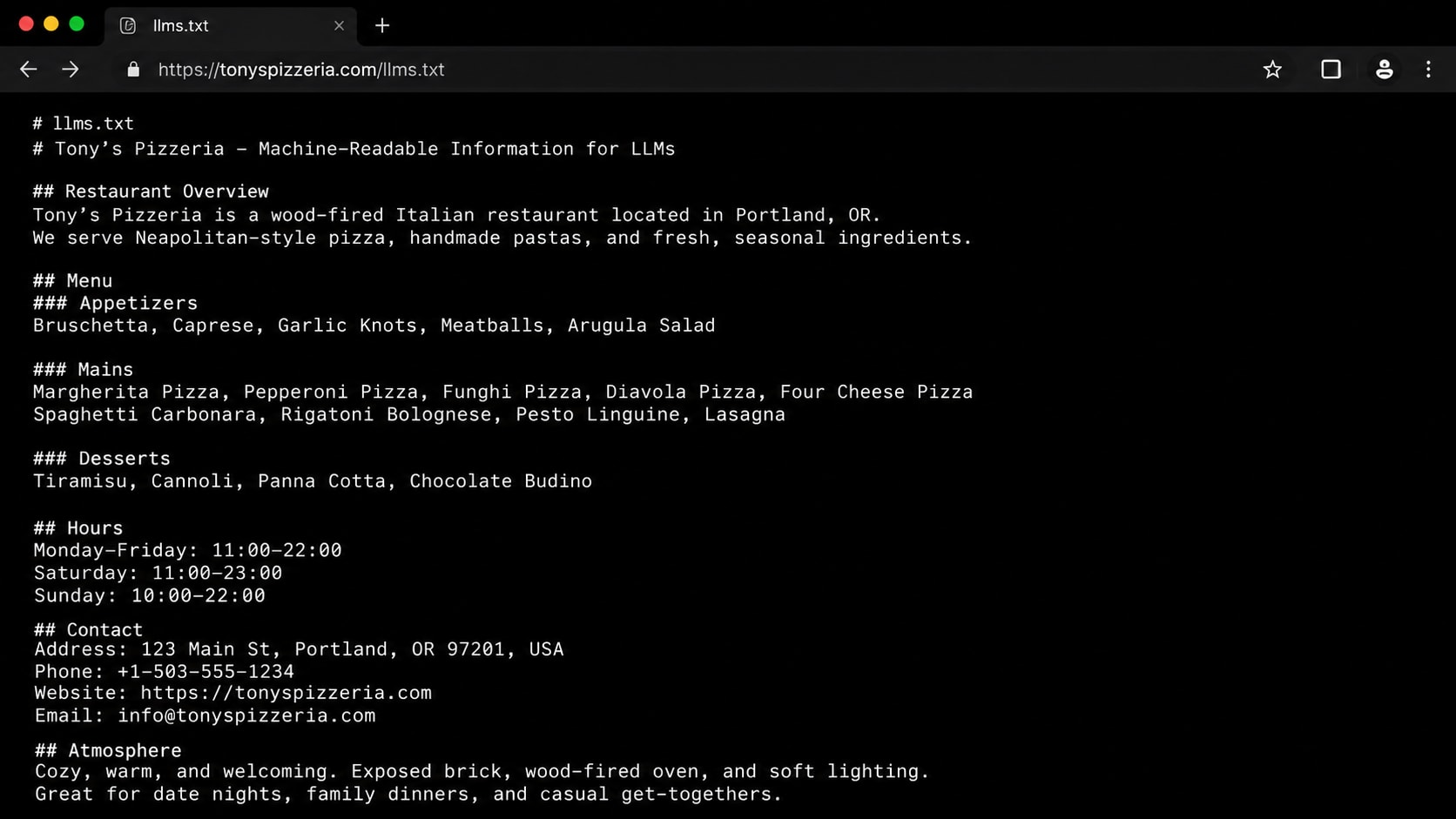
An llms.txt file for restaurants is a structured text document that contains menu information, restaurant details, and key facts formatted specifically for AI consumption. Unlike traditional web content designed for human readers, llms.txt files organize information in ways that AI assistants like ChatGPT, Claude, and Perplexity can quickly scan, understand, and cite when making restaurant recommendations.
The file format follows specific conventions that make restaurant data immediately accessible to AI systems, eliminating the need for complex parsing of websites, PDFs, or unstructured content. Most restaurants can create effective llms.txt files in under an hour once they understand the required format and essential information to include.
What exactly is an llms.txt file for restaurants?
The llms.txt format provides a standardized way to present restaurant information that AI systems can easily read and reference. The file contains structured sections covering menu items, restaurant characteristics, operational details, and other information that helps AI assistants make informed recommendations.
File structure follows a consistent pattern: restaurant overview, menu sections organized by category, pricing information, operational details like hours and contact information, and descriptive elements that help AI systems understand when to recommend the establishment.
Content organization prioritizes AI parsing efficiency over visual appeal. Information appears in labeled sections with clear headings, consistent formatting, and minimal decorative elements that might confuse automated reading systems.
Location and accessibility matter for effectiveness. The llms.txt file must be hosted at a predictable web location where AI systems can find and access it, typically as part of the restaurant's main website or a dedicated hosting service.
The goal is creating a single, authoritative source of restaurant information that AI systems can reference quickly and accurately when generating recommendations for users.
How do you structure an effective restaurant llms.txt file?
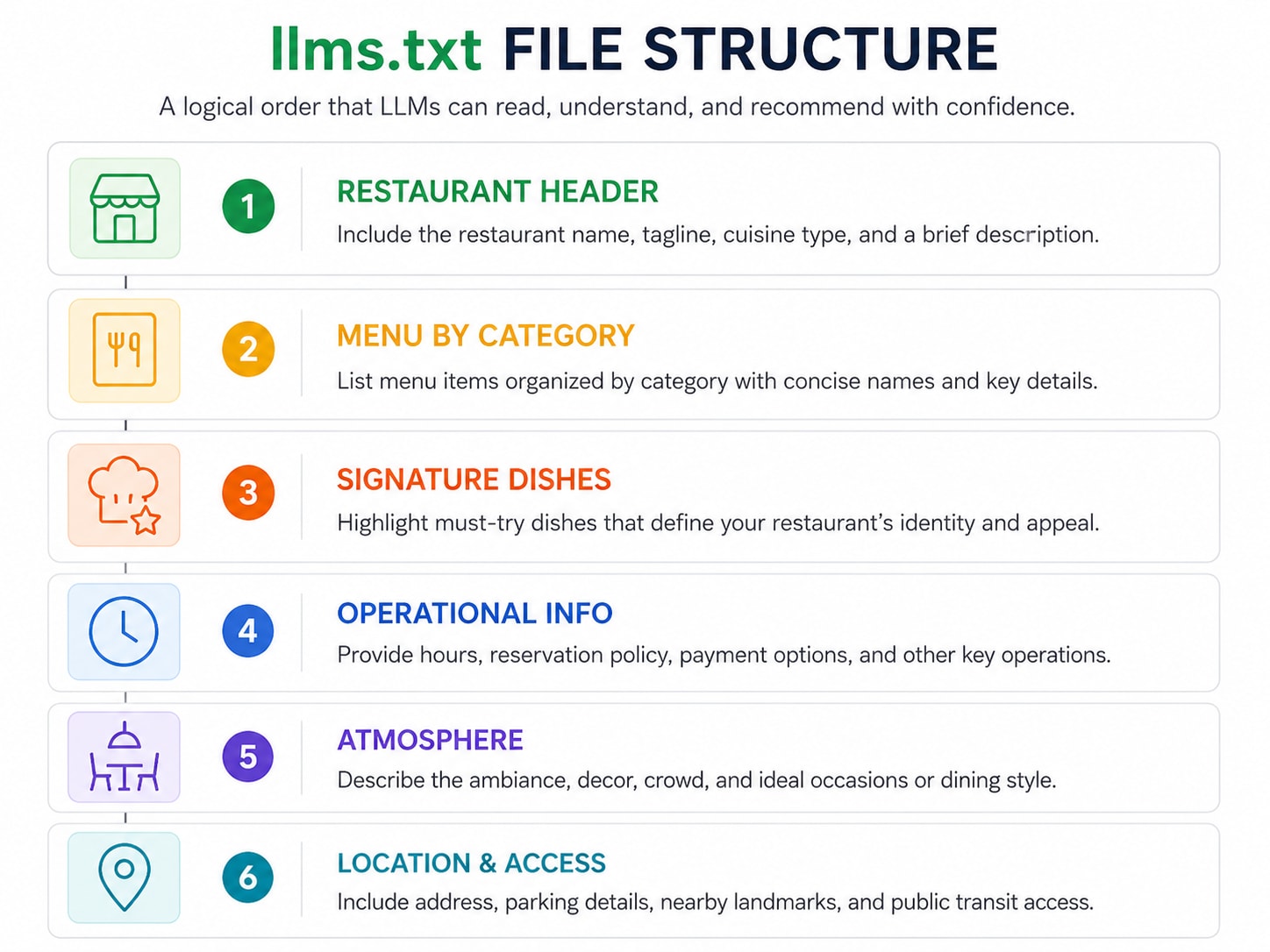
Effective llms.txt files for restaurants follow a logical information hierarchy that matches how AI systems process and categorize dining establishments.
Restaurant header section includes the establishment name, cuisine type, location, and brief overview description. This section helps AI systems categorize the restaurant and understand its basic characteristics.
Menu organization by category presents food and beverage options in logical groups: appetizers, mains, desserts, drinks. Each menu item should include the name, brief description, and price when possible.
Specialties and signature dishes receive prominent placement since AI systems often recommend restaurants based on particular items or cooking styles. Highlight dishes that distinguish your restaurant from competitors.
Operational information section covers hours, contact details, reservation policies, seating capacity, takeout availability, and delivery options. This practical information helps AI systems make recommendations based on user requirements.
Atmosphere and experience descriptors provide context about dining room style, appropriate occasions, noise level, and typical customer demographics. This helps AI systems match restaurants to specific user needs.
Location and access details include neighborhood context, parking information, public transportation access, and nearby landmarks that help with geographic recommendation accuracy.
Each section should use clear headings and consistent formatting that AI systems can recognize and parse efficiently.
What menu information should you include in llms.txt?
Menu content in llms.txt files requires balancing comprehensiveness with readability for AI systems. Include enough detail for AI assistants to understand your offerings without overwhelming the file with excessive information.
Item names should be descriptive and clear rather than creative or ambiguous. "Grilled Atlantic Salmon with Lemon Herbs" works better than "Chef's Special Fish" for AI understanding and customer expectations.
Brief item descriptions help AI systems understand ingredients, preparation methods, and dietary characteristics. Focus on key ingredients, cooking techniques, and notable features rather than promotional language.
Pricing information enables AI systems to make recommendations based on budget constraints. Include current prices when possible, or indicate price ranges if specific prices change frequently.
Dietary indicators like vegetarian, vegan, gluten-free, or allergen information help AI systems match menu items to users with specific dietary requirements.
Portion sizes or serving suggestions provide context that helps AI systems recommend appropriately for different group sizes or appetite levels.
Seasonal or limited availability should be noted for items that aren't always available, helping AI systems avoid recommending unavailable options.
Organize menu content in logical categories that reflect how customers typically browse dining options rather than internal kitchen organization.
How do pricing and availability details work in llms.txt?
Pricing and availability information in llms.txt files helps AI systems make practical recommendations based on user budget and timing constraints.
Current pricing should be included when prices remain stable for extended periods. Use specific dollar amounts when possible since AI systems can filter recommendations based on budget requirements.
Price ranges work better than specific prices for restaurants with frequently changing costs or market pricing. Use descriptive ranges like "Entrees $18-32" rather than listing every possible price variation.
Availability schedules for items that aren't offered continuously help prevent AI systems from recommending unavailable options. Note lunch-only items, weekend specials, or seasonal offerings clearly.
Special pricing like happy hour discounts, early bird menus, or promotional offers can be included if they represent ongoing availability rather than temporary promotions.
Group pricing or minimums for catering, large parties, or special menus help AI systems make appropriate recommendations for different party sizes.
Payment methods and policies like cash-only, tip inclusion, or service charges provide practical information that affects customer experience and budget planning.
Update pricing and availability information regularly to maintain AI recommendation accuracy and prevent customer disappointment with outdated information.
What operational details matter most for AI recommendations?
AI systems rely heavily on operational information to match restaurants with user requirements and practical constraints. Include comprehensive details about how your restaurant functions.
Hours of operation should include regular hours for each day, special holiday schedules, and any seasonal variations. AI systems frequently filter recommendations based on current availability.
Reservation policies help AI systems recommend appropriately for different group sizes and occasions. Specify whether reservations are required, recommended, or not accepted.
Seating and capacity information includes total seating, private dining options, bar seating, outdoor areas, and accommodation for large groups. This helps AI systems match restaurants to party size requirements.
Service style details like full service, counter service, buffet, or family-style help AI systems understand the dining experience and recommend appropriately for different occasions.
Takeout and delivery options with coverage areas, minimum orders, and timing help AI systems recommend for users preferring off-premise dining.
Accessibility features like wheelchair access, parking availability, and public transit connections ensure AI systems can recommend appropriately for users with specific mobility requirements.
Special services like catering, private events, or live entertainment provide additional context for occasion-based recommendations.
Include only current, accurate operational information since incorrect details can reduce AI recommendation confidence.
How should you describe restaurant atmosphere and experience?
Atmosphere descriptions in llms.txt files help AI systems understand when your restaurant fits specific dining occasions and customer preferences.
Physical environment descriptors should include lighting (bright, dim, intimate), noise level (quiet, lively, bustling), and overall ambiance (casual, upscale, family-friendly). These characteristics help AI systems match restaurants to user mood and occasion requirements.
Typical customer demographics like business professionals, families, young adults, or neighborhood regulars provide context about who feels comfortable in your restaurant and for what occasions.
Appropriate occasions explicitly state when your restaurant works well: date nights, business meetings, family celebrations, casual meals, special occasions. AI systems use this context for occasion-based recommendations.
Design and decor elements that affect the dining experience: outdoor seating, open kitchen, bar area, private rooms, or distinctive interior features that create particular atmospheres.
Service style characteristics like attentive fine dining service, casual counter ordering, or family-style sharing help set customer expectations and match restaurants to preferred dining styles.
Entertainment or special features like live music, sports viewing, game areas, or special events that might influence restaurant selection for particular occasions.
Focus on objective characteristics rather than subjective quality claims. AI systems need descriptive information they can match to user preferences rather than promotional language.
What common mistakes should you avoid in restaurant llms.txt files?
Several formatting and content errors can reduce the effectiveness of restaurant llms.txt files or prevent AI systems from parsing them correctly.
Inconsistent formatting across sections makes it difficult for AI systems to recognize information categories and extract relevant details efficiently. Use consistent heading styles and section organization throughout the file.
Overly promotional language can trigger AI spam detection or make information less useful for practical recommendations. Focus on descriptive, factual content rather than marketing copy.
Incomplete or outdated information reduces AI recommendation confidence. Ensure all sections contain current, accurate details and update the file when operational changes occur.
Generic descriptions don't provide the specific characteristics AI systems need to match restaurants to user requirements. Avoid vague terms like "great food" in favor of specific cuisine details and distinctive features.
Complex or creative formatting may confuse AI parsing systems. Stick to simple, clear text formatting rather than elaborate visual elements or unusual organization patterns.
Missing pricing or availability information prevents AI systems from making recommendations based on budget or timing constraints. Include practical details that affect customer decisions.
Excessive detail can overwhelm the file and make important information harder for AI systems to locate. Focus on essential details rather than comprehensive descriptions of every possible aspect.
Focus on creating clear, accurate, useful information that serves both AI systems and potential customers effectively.
How do you host and maintain your restaurant's llms.txt file?
Proper hosting and ongoing maintenance ensure your restaurant's llms.txt file remains accessible and effective for AI discovery.
File location should be predictable and consistent. Host the file at a standard location like yourrestaurant.com/llms.txt or use a dedicated hosting service that provides reliable access for AI systems.
Regular updates maintain accuracy and signal to AI systems that your restaurant information remains current. Update the file when menus change, hours adjust, or operational details shift.
Backup hosting options prevent access problems if your primary website experiences issues. Consider hosting copies through multiple channels or using specialized services designed for AI-readable content.
Access monitoring helps identify when AI systems successfully access your file versus when technical problems prevent discovery. Simple web analytics can track file access patterns.
Format validation ensures your llms.txt file remains properly structured as you make updates. Test file accessibility and formatting after changes to prevent parsing problems.
Integration with website updates streamlines maintenance by automatically updating the llms.txt file when you modify menu or operational information elsewhere on your website.
LLMenu provides automated llms.txt hosting and maintenance that handles formatting, hosting, and updates while ensuring optimal AI accessibility for your restaurant information.
The goal is making your restaurant information consistently available to AI systems while minimizing the ongoing maintenance burden on restaurant staff.
How can you measure llms.txt file effectiveness?
Tracking the performance of your restaurant's llms.txt file requires monitoring AI discovery patterns and recommendation frequency across different platforms.
Direct AI testing provides the most reliable measurement. Regularly query major AI assistants with searches relevant to your restaurant and track when your establishment appears in recommendations.
Query variation testing reveals how effectively your llms.txt content matches different search patterns. Test location-based queries, cuisine searches, price-based requests, and occasion-specific questions.
Competitive analysis shows how your AI visibility compares to similar restaurants in your market. Test queries that include competitor names to understand relative recommendation frequency.
File access analytics track when AI systems access your llms.txt file, providing insight into discovery activity even when you don't see direct recommendation results.
Customer feedback about AI-driven discovery can reveal when your llms.txt file successfully drives foot traffic through AI recommendations.
Recommendation context analysis helps understand what aspects of your restaurant AI systems emphasize when making suggestions, guiding content optimization efforts.
Most restaurants find that llms.txt effectiveness builds gradually as AI systems encounter and process the information over several weeks of consistent availability.
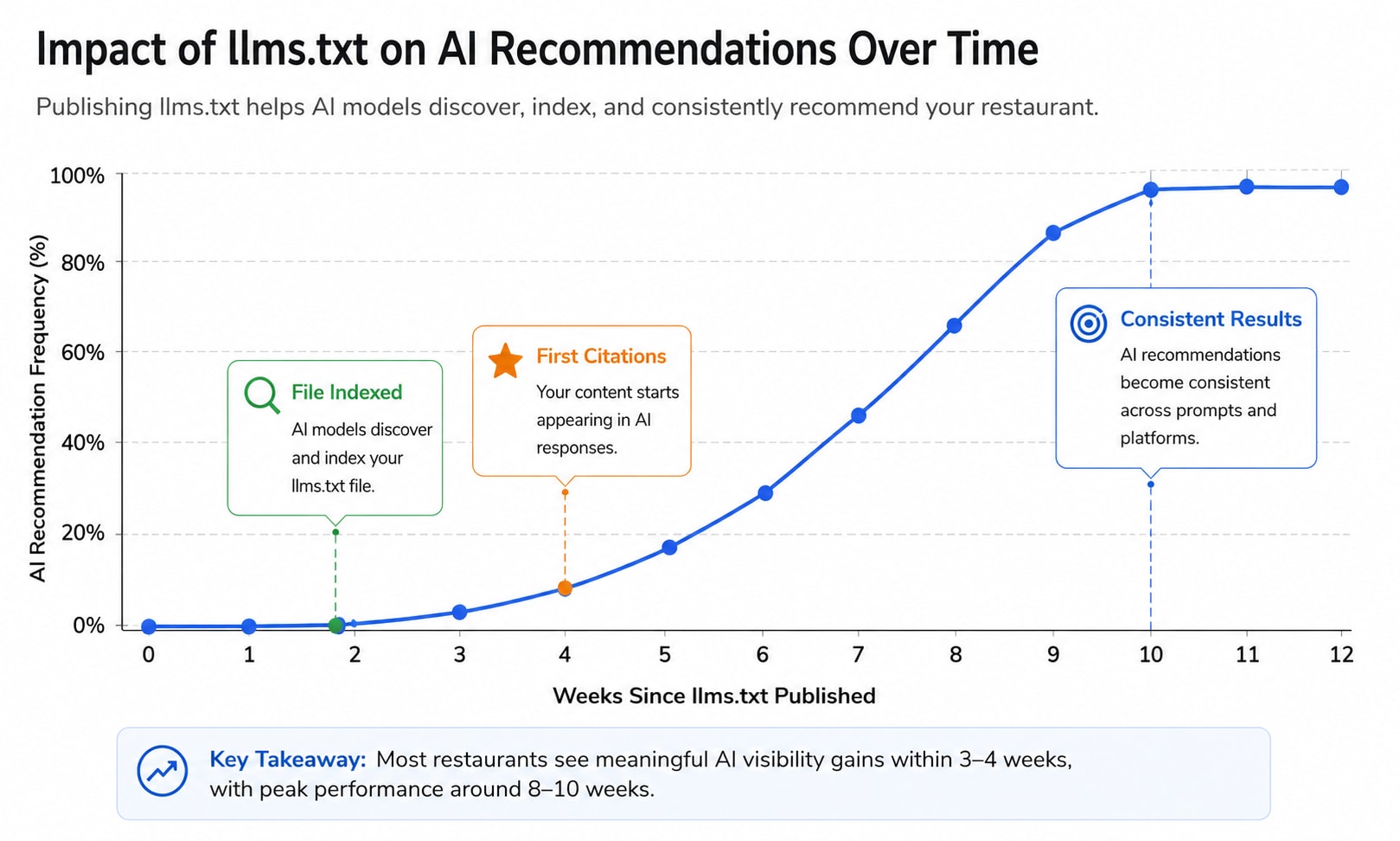
The investment in creating and maintaining an effective llms.txt file typically pays returns through increased AI visibility and recommendations that drive customer discovery.
Getting started with your restaurant's llms.txt file
Begin with essential information: restaurant name, location, cuisine type, hours, and menu highlights. A basic llms.txt file works better than no file while you develop more comprehensive content.
Focus on accuracy over completeness initially. Correct information in fewer categories performs better than extensive but inaccurate details across many sections.
Test and refine based on AI recommendation patterns. Monitor how your restaurant appears in AI suggestions and adjust content to improve recommendation accuracy and frequency.
Consider using LLMenu for automated llms.txt generation, hosting, and maintenance if manual file creation and updates become burdensome for your restaurant operations.
The goal is making your restaurant's key information easily discoverable by AI systems that increasingly influence how customers find and choose dining options.
Frequently Asked Questions
How often should I update my restaurant's llms.txt file? Update the file whenever significant changes occur: menu modifications, hour changes, pricing adjustments, or new services. Monthly reviews ensure information stays current even for minor changes.
Can I include photos or images in an llms.txt file? No, llms.txt files contain only text content. Images should be hosted separately on your website where AI systems can access them through normal web crawling.
Should I include competitor information in my llms.txt file? No, focus only on your own restaurant information. AI systems will access competitor data from their own sources when making comparative recommendations.
What's the ideal length for a restaurant llms.txt file? Most effective restaurant llms.txt files range from 800-2000 words, providing comprehensive coverage without overwhelming AI parsing systems with excessive detail.
Do I need technical knowledge to create an llms.txt file? Basic llms.txt files require only simple text editing skills. LLMenu can automate the process for restaurants preferring not to handle technical implementation directly.